What is a User Persona, and Why is it Useful?
A user persona represents the target audience of the product or service. By looking for patterns or overlapping information in the data collected during the user research phase, we identify the key information for creating the personas.
Creating user personas helps us understand
These personas represent users whose goals and characteristics resonate with the needs of a larger group of users.
Persona representations include behavioral patterns, goals, motivations, skills, attitudes, and background information. Using personas, a design that serves real users can be created.
Knowing your users and their wants is critical to developing products that provide them with the best user experience.
The user research that is done during the UX design process is crucial. This is where user personas come into the picture.
What Makes a Good User Persona?
A good user persona should be based on accurate data and observations and show how users behave.
It should focus on the current state of interaction with a product rather than
It must be context-specific, capturing the behaviors and goals related to that particular product or service.
A well-crafted user persona should be a detailed, accurate representation of the target user group and their needs.
In summary, a persona should be realistic and relevant to the target audience for any use in product design.

Get personalized design solutions for your UX challenges.
Talk to us!
Different Types of Personas
There are mainly 9 types of user personas. They are:
- Goal-oriented Personas
- Role-based Personas
- Engaging Personas
- Fictional Personas
- Psychographic Personas
- Technographic Personas
- Ethnographic Personas
- Demographic Personas
- Hybrid Personas
Goal-oriented Personas
Personas with specific goals in mind are committed as quickly and efficiently as possible by utilizing the product.
This type of persona requires clear navigation paths that allow them to access the resources and information they need with minimal effort.
Examples include a shopper looking for the best deal online or a student searching for educational materials.
Role-based Personas
Role-Based personas represent specific organizational roles, such as lead engineers or marketing executives. They have specialized tasks that must be completed, so it’s important to design systems and interfaces with these individual roles in mind.
This type of persona requires a transparent and efficient workflow that allows them to quickly complete their tasks and any additional tasks that arise from the user’s role.
Engaging Personas
Engaging personas are users who enjoy interacting with the product or service. These types of users tend to be more open-minded and exploratory in interacting.
Designing for these personas requires elements that draw the user’s attention and keep them engaged, such as immersive visuals, engaging content, micro-interactions, and intuitive navigation paths.
Fictional Personas
Fictional personas are representative of a specific demographic or segment of users who are not using the product or service.
Creating fictional personas is beneficial when you want to gain insight into how a particular demographic may interact with your product or service, even if they are not using it.
Understanding user personas is essential for creating successful products and services tailored to a specific audience’s needs.
Psychographic Personas
These personas focus on psychological attributes such as lifestyle, values, interests, and attitudes.
They provide insight into the emotional and cognitive factors that drive user behavior, which helps tailor marketing messages and user experiences that resonate with the target audience.
Technographic Personas
These personas consider users’ technology preferences and usage habits, such as device types, operating systems, and preferred software applications.
By understanding their audience’s technology preferences, businesses can optimize their offerings for specific devices and platforms, ultimately improving the user experience.
Ethnographic Personas
These personas consider users’ cultural backgrounds, social roles, and environments.
Acknowledging these factors assists businesses in crafting culturally competent messaging and user experiences, catering to the diverse needs of their audience and promoting inclusivity.
Demographic Personas
They are based on demographic factors such as age, gender, income, education, and location.
Understanding these demographic segments allows businesses to design products and services aimed at the right audience from a demographic standpoint.
Hybrid Personas
Hybrid personas combine elements from multiple persona types to create a more comprehensive understanding of a user group.
These personas may integrate demographic, psychographic, behavioral, and other aspects to understand a user’s needs and preferences better.
Why User Personas?
- Personas can guide you to understand the motivations and needs of your potential users. This knowledge can predict your users’ expectations and future actions.
- A common goal or vision can be communicated through user personas throughout your organization. Communications regarding user experience, information architecture, messaging, branding, etc, will find common ground as creating imaginary users can help to focus on the same goals.
- Personas will also indicate the tone of language, messages, and imagery your users would resonate with.
How to Create User Personas
#Step 1: Research your Target Users
If you want to base your persona on accurate data, first, you should gather information about your target audience. Personas built on imaginary data will be unreliable in most cases as you cannot develop solutions the real users need.
- Talk to 5 potential users to understand their needs and expectations.
- Utilize the information you gained from previous user experiences to make accurate assumptions about future requirements.
- Quantitative data collected through web analytics can be used to analyze the actions of the users even though the reason behind it still stays hidden.
The research should also tell you which channels are majorly used by your target audience, as the same channels can be used to reach them.
#Step 2: Understanding and Segmenting Users
It is essential to sort the research participant groups according to their behavior. Similar attributes representing different behaviors of the users when they complete a task, achieve goals, etc., should be identified and categorized together.
You can create different user personas for the project based on these categories.
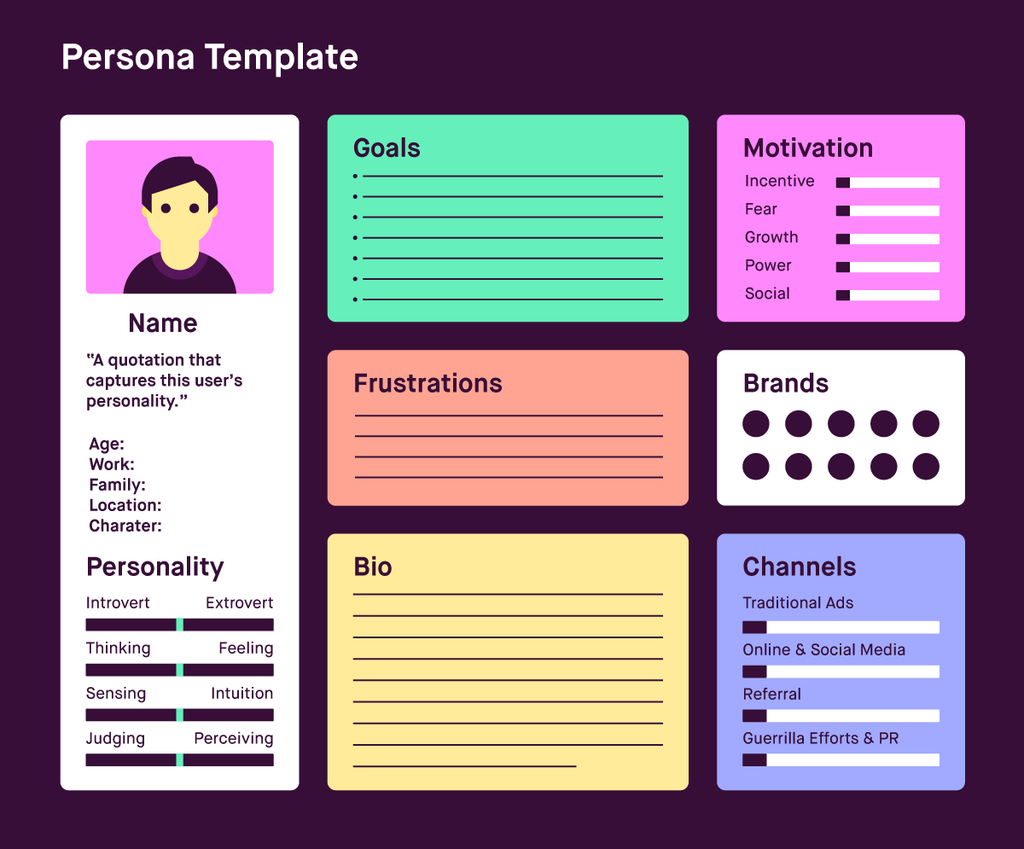
#Step 3: Decide on a layout or persona template
The layouts of the persona differ according to the persona type and purpose.
Certain websites provide ready-to-use or pre-filled templates. You may choose from these according to your need. They also allow you to add new sections to these prevailing templates.
Once the layout is decided, and a persona is created, you may keep it as a template, which will help maintain consistency across your projects.
#Step 4: Choose Demographic Information
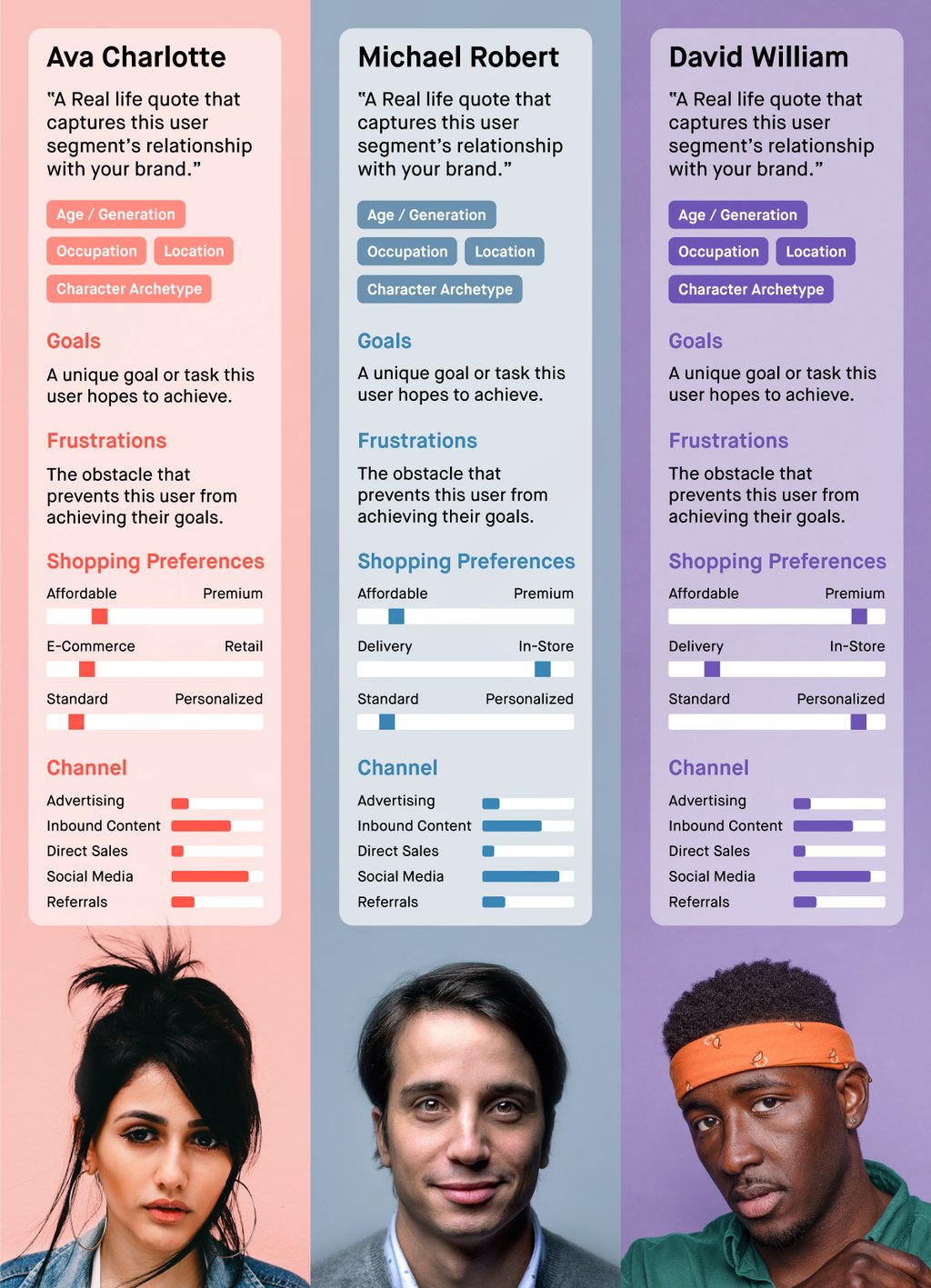
Giving your personas relatable names, ages, gender, place of residence or origin, occupations, etc., can help evoke empathy while providing insights into personality traits. Details like marital status, income, etc., can also be added.
The persona’s name should be selected wisely as a name can impart generalized assumptions to people viewing the document. The message the title conveys to its viewers is essential.
You may use personality tests conducted among users during research to record personality traits. These personality traits include introverts, outgoing, energetic, etc. You should choose adjectives that help you differentiate one user’s personality traits from another.
An image should be chosen to represent the persona. But staged photos or photographs of famous figures should be avoided.
#Step 5: Persona’s Background
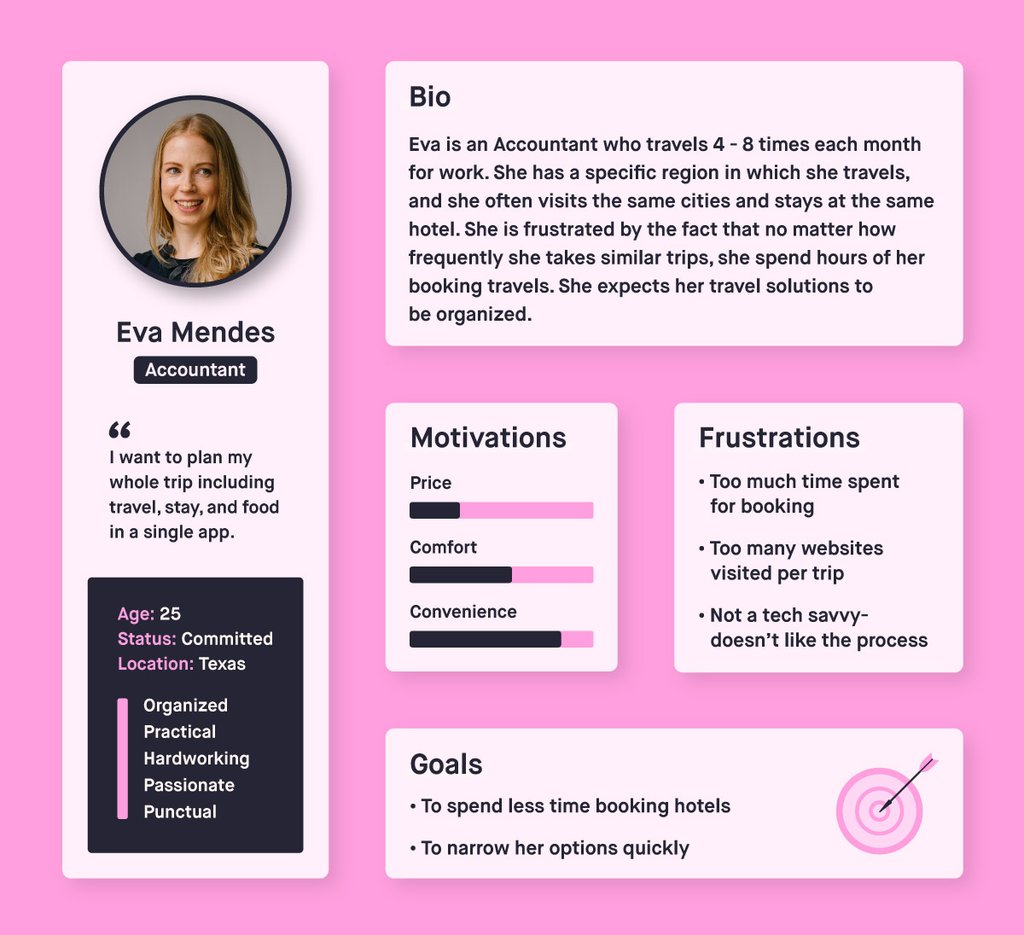
Details regarding the persona’s background should be recorded as it might lead to new insights.
At the same time, the persona should not be overloaded with information. It should contain only valuable and insightful information. This information should reflect trends observed from interviews and surveys.
#Step 6: Persona’s Goals
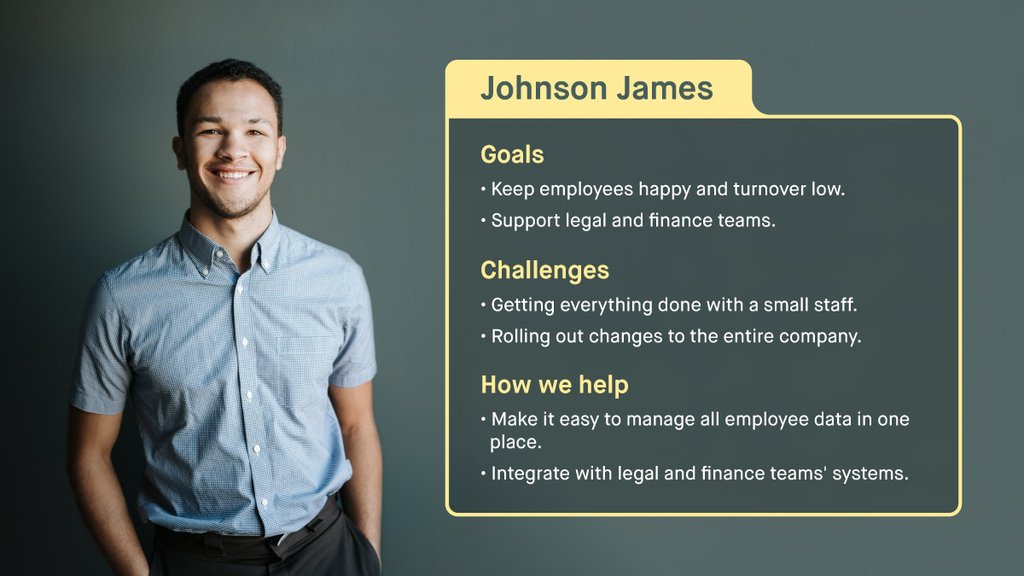
Understanding the persona’s goals helps you to align your goals with theirs.
The users should ultimately achieve their goals by using your product. The end goal can be tangible or intangible. E.g.,
Tasks where completing an action is the goal, or the user can look for experience goals like fun, feeling relaxed, etc.
Channelizing your efforts and resources towards similar goals will ensure better results.
#Step 7: Define Motivations and Frustrations
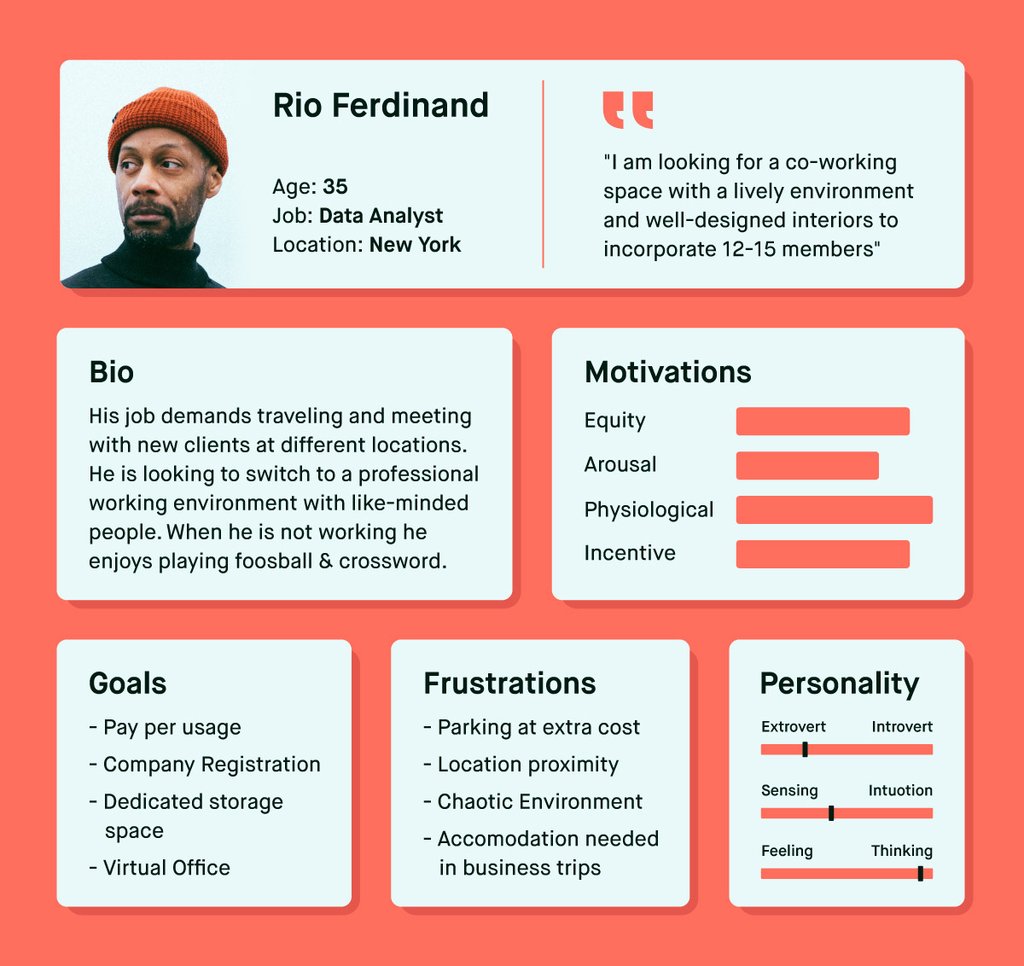
Your findings of what motivates or frustrates the users should be included in personas.
This understanding helps you to serve the users better as this knowledge allows you to make necessary improvements to your product, eventually providing a better user experience.
#Step 8: Quote
The persona’s attitude towards your product should be documented. This includes the value they find in the product, the solutions they seek, etc.
You may make use of actual quotes or comments by the users acquired from user interviews, surveys, or questionnaires.
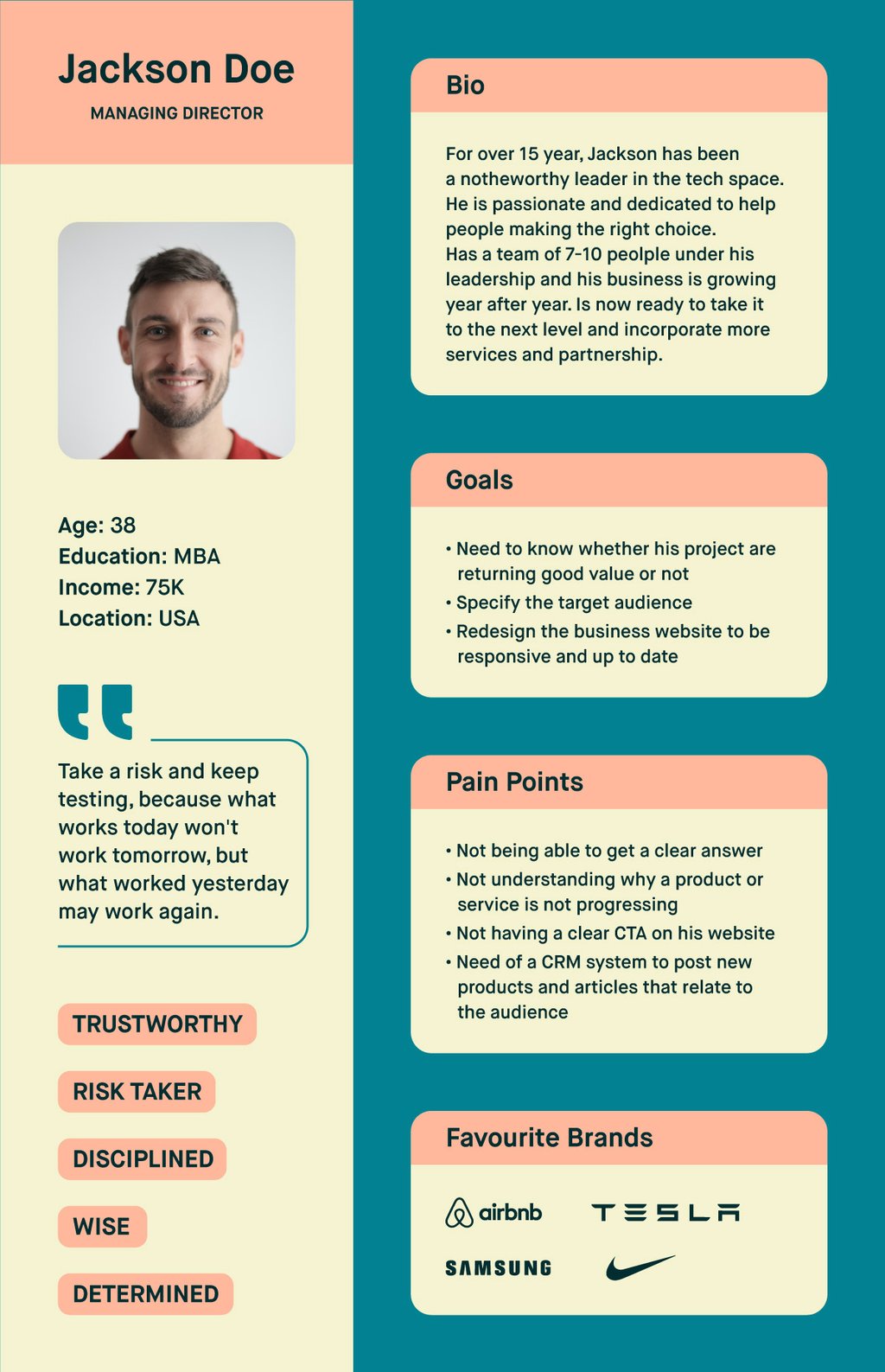
#Step 9: Tier Section
This section is critical while defining a persona. Tier refers to the level of engagement the user has with the product. They can be first-time users, late adopters, etc.
The tier can also refer to the users’ knowledge or adaptability to the product. E.g., professionals, enthusiasts, and so on.
The user’s level of commitment toward the products can also be stated through these tiers. E.g., Free users, paid users, etc.
#Step 10: The Bio and the Extra details
By this time, the persona you build is ready.
But you may still add a few more personal details like their skills, knowledge, the technology used by them, the brands they use, and more to make the persona more personalized and detailed.
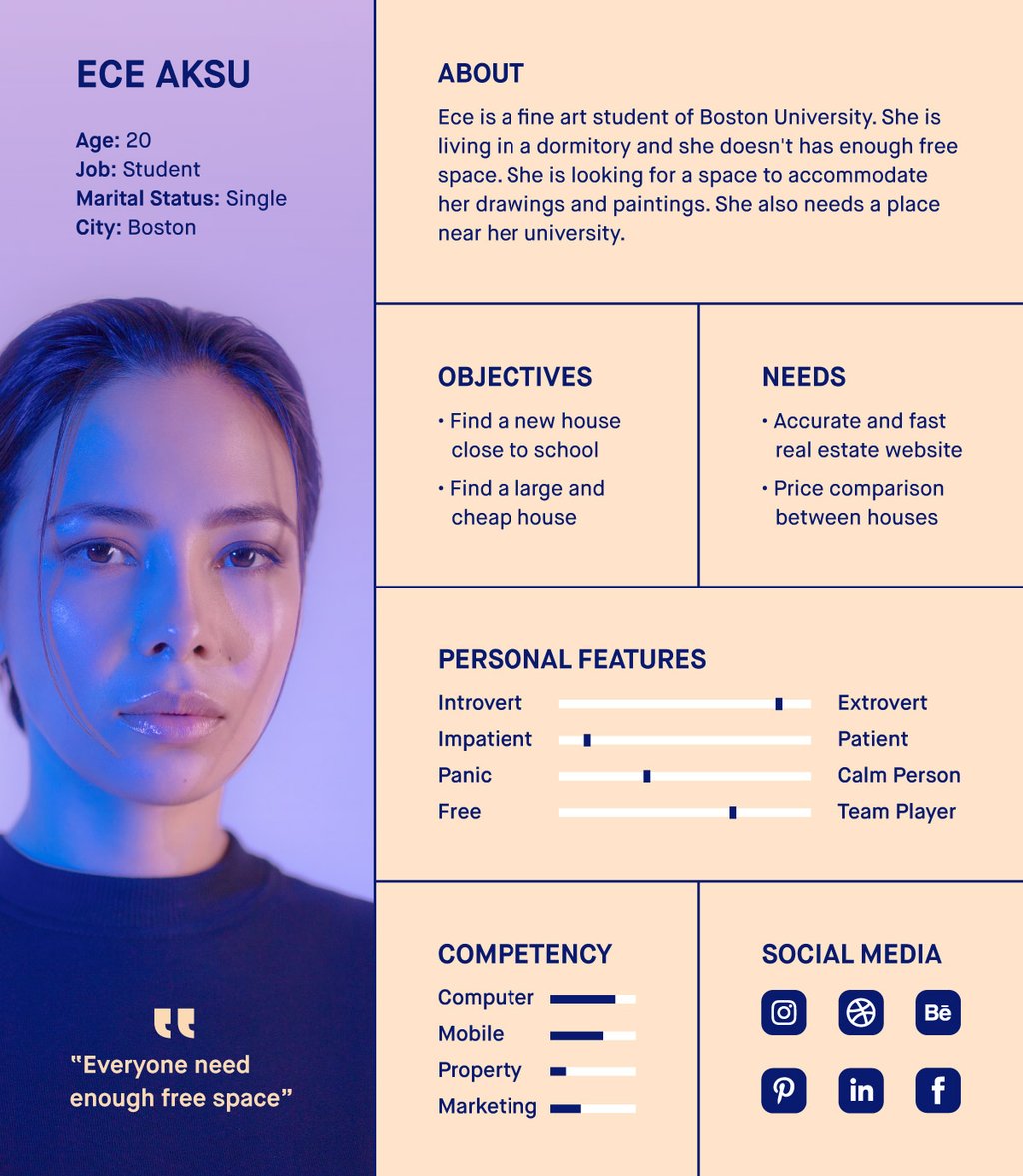
A Complete User Persona Example
Everything above is easier to apply once you see a finished persona end to end. Here is a complete example for a fictional personal-budgeting app called Pennywise. Treat it as a template you can adapt: keep the section labels, swap in your own research, and resist the urge to invent details your data does not support.
Name, Age, Occupation, Location
Priya Nair, 29. Junior marketing associate at a mid-size SaaS company. Lives in Pune, India, renting a one-bedroom flat.
Bio
Priya moved to Pune three years ago for her first full-time job. Her salary is comfortable but not generous, and rent, an education loan, and the occasional weekend trip eat into it faster than she would like. She has tried budgeting before, mostly in a spreadsheet she abandoned after a few weeks. She wants to save for a postgraduate course in two years, but she is not sure where her money actually goes each month.
Goals
- Understand where her money goes each month without manual data entry.
- Build an emergency fund and save steadily toward a postgraduate course.
- Pay down her education loan a little faster than the minimum.
Frustrations and Pain Points
- Manual expense tracking feels like a chore, so she stops doing it within weeks.
- Most finance apps assume a level of investing knowledge she does not have yet.
- She worries about linking her bank account to an app she does not fully trust.
Motivations
Priya is motivated by a sense of progress and control. Seeing a savings number climb, however slowly, keeps her engaged far more than warnings about overspending. She wants to feel financially independent before any major life decisions, and she likes tools that make her feel competent rather than scolded.
Behaviours and Tech Comfort
Comfortable with technology and almost entirely mobile-first. She manages everything from her phone, pays with UPI and cards, and rarely opens a laptop outside work. She is privacy-aware: she reads permission prompts and abandons sign-ups that ask for too much too soon. She responds well to gentle nudges but ignores anything that feels like spam.
Preferred Channels
- In-app push notifications for weekly summaries (welcome, if not too frequent).
- Instagram and YouTube for personal-finance tips and creator reviews.
- Email only for important account or security updates, not marketing.
Quote
"I do not need someone to tell me I spent too much. I need to actually see where it went, without spending an hour a week logging receipts."
Want to build your own?
Download the Free User Persona Template
Download PDF template
Download our free User Persona Template (PDF) — print it, fill it in from real research, and share it with your team.
User Personas in 2026: AI-Generated and Synthetic Personas
Persona work used to stall at the writing stage. You had the interviews and the survey data, but turning them into clear, shareable profiles took days. In 2026 that part is faster. AI helps you cluster research, draft persona narratives, and even rehearse interview questions in minutes rather than days.
Several tools now build this into the workflow. UXPressia offers AI-assisted persona and journey-map generation. Maze and Dovetail use AI to synthesize patterns across usability tests and interview transcripts, which is often where personas actually begin. Delve.AI generates data-driven personas from analytics and CRM signals. And general-purpose models like ChatGPT and Claude are widely used to draft proto-personas from a pile of raw notes, then to pressure-test them with questions a real user might ask.
The caveats matter as much as the speed. A persona an AI invents from a prompt, with no real research behind it, is a synthetic persona, and synthetic personas can hallucinate. They will happily produce confident details that no user ever said, and they can quietly encode the biases and stereotypes baked into their training data. A polished AI persona feels authoritative precisely when it is least grounded, which is the dangerous part.
The healthy posture is simple: AI amplifies the draft; real research and human judgment ground it. Use AI to move faster through synthesis and first drafts, then validate every persona against actual interviews, analytics, and observed behavior. If a goal or frustration cannot be traced back to something a real user did or said, treat it as a hypothesis to test, not a fact to design around.
Tips for Creating Better User Personas
- Avoid using imaginary details just because the personas created are imaginary. The key to making a compelling persona is doing proper research and including accurate data.
- Conduct customer surveys and use the right questions to understand the users’ personality traits and demographic details.
- Multiple personas should be created to represent a large user base that is diverse and too vast to represent in a single persona.
- Never neglect a bio, as this helps bind all the data collected through research and turns the data into a life-like description representing a person that will seem more realistic and relatable.
- Sites like Xtensio provide templates to create personas. You can make use of these to speed up your process.
- Understanding how your users use your product and their experiences gives you first-hand data for your persona. You can map the customer’s journey and understand the users better.
- Illustrations and visual content can be used to make the context very clear to the viewers of the persona. This also makes the persona developed more memorable and helps in triggering emotions.
- Try to highlight at least one metric that shows crucial differences or similarities among the users. This helps in segmenting the personas into the right groups.
- Personality traits or skills can be represented on a sliding scale rather than keeping it specific. With this, stereotyping of the personas can be avoided.
- A persona should not be too long or descriptive. Anyone should be able to grasp the information it provides in a single glance.
Main Challenges and Their Solutions in Creating a User Persona
#1: Lack of Understanding
- Personas are themes in qualitative data which are generalizations and not a perfect science.
- Thus researchers or stakeholders can be skeptical about the validity of personas.
Solution
- Make stakeholders understand how vital personas are to the project even before creating the personas.
#2: Inaccurate Expectations
- To make the most of the investment they put in for personas, stakeholders expect detailed personas that cover a lot of data. But these long personas lack data actionable for specific design projects.
- Personas with a target focus seem more effective as the data collected can help with specific workflow or features and directly influence design.
Solution
- Understand stakeholder’s goals
- Provide the right tool for the job
- Help them understand their scope of influence
#3: Uncertainty About how Personas Can be Used
Not everyone is familiar with user personas, which cannot be easy to understand. It will be helpful in the design process.
Solution
- Do not show it as a piece of artwork
- Refer to personas in design discussions
- Make use of personas in a practical sense
#4: Designers Create Personas Solely
Personas are often created by designers and imposed. People can be skeptical about the result as they don’t know when and where it was created.
Solution
Do not create them alone and deliver them to users. Stakeholders should be involved in understanding how different persona themes were derived.
Key Takeaways
Developing personas helps you understand your users, what they expect from your product, and the best ways to engage and serve them.
By creating accurate personas, you can ensure that your product or service is designed to meet your users’ needs.
Personas, like the majority of design elements, can be produced iteratively. Throughout all later phases of the design process, personas will guide decision-making by the team.
Personas are a valuable tool for any UX designer, as they can significantly assist them in shaping product strategy and accompanying them during usability testing sessions.
FAQs
How Can a User Persona Improve Your Business?
A user persona can be incredibly beneficial for your business, as it helps you better understand and meet your customers’ needs.
Creating a user persona will give you insight into your target audience, goals, motivations, values, and pain points.
This information can then be used to inform marketing strategies that are tailored to the target audience’s interests and preferences.
By understanding the user persona, you can optimize the design and other customer experience elements to deliver a practical and enjoyable experience that meets your customers’ needs.
Focusing on user personas can help you create products or services specifically designed for each segment’s needs, allowing you to increase sales and generate more revenue for your business.
What is User Persona in Design Thinking?
User persona in Design Thinking is a fictional representation of a user for whom the designed product or service is intended.
It represents the characteristics and needs of a user group and helps designers empathize with their users.
User personas help identify problems, develop better design ideas, prioritize features, build consensus amongst the team, and predict user behavior to create better designs.
User personas are created by researching existing users and interviewing potential customers.
The goal is to accurately represent the different types of people using the product by gathering information about their goals, values, attitudes, motivations, frustrations, and how they interact with technology.
This data can be used to uncover factors that influence how users experience a product or service design. Once these personas have been created, they can be used as reference points during development.
User personas provide designers with actionable insights into their customer’s needs and preferences so that they can develop products and services tailored specifically to them.
This method helps designers think from the user’s perspective when designing products or services, ultimately leading to improved user experience (UX).
What’s a User Persona Generator?
A User persona generator is a tool that helps designers create specific user profiles and personas. These tools allow users to quickly create detailed user profiles based on their research.
The design team can use this information to create better user experiences and products. Some of the popular User persona generators are Xtensio, MakeMyPersona, UXPressia, Delve.AI, etc.
Can AI create user personas?
Yes, AI can draft user personas quickly, and tools like UXPressia, Delve.AI, Maze, Dovetail, and general models such as ChatGPT and Claude are commonly used for this. The catch is that a persona generated without real research is a hypothesis, not a finding. AI is best used to accelerate synthesis and first drafts, with every persona then validated against actual user research before you design around it.
How often should you update a user persona?
Review your personas at least once a year, and sooner whenever something material changes: a new audience segment, a pivot in your product, fresh research, or a shift in user behavior. Personas describe real people, and real people change, so a persona that is never revisited slowly drifts from reality and quietly misleads the teams that rely on it.
References and Further Reading
If you want to go deeper, these are the primary and authoritative sources behind modern persona practice.
- Alan Cooper, The Inmates Are Running the Asylum (1999) — the book that introduced personas to a wide audience and made the case for goal-directed design.
- Nielsen Norman Group, Personas Make Users Memorable — a clear, research-backed overview of what personas are and how to use them well.
- Interaction Design Foundation, Personas topic page — an evolving introduction with definitions, videos, and a practical creation process.
- Lene Nielsen, Personas in The Encyclopedia of Human-Computer Interaction (2nd ed.) — a foundational academic chapter on persona methodology by a leading persona researcher.
How to Cite This Article
If you are referencing this guide in academic or professional work, here are ready-to-use citations in two common styles.
APA 7
Sethulakshmi, V. (2026). User persona: Everything you need to know [With examples]. WowMakers. https://www.wowmakers.com/blog/user-persona/
MLA 9
Sethulakshmi V. "User Persona: Everything You Need to Know [With Examples]." WowMakers, 2026, www.wowmakers.com/blog/user-persona/.